
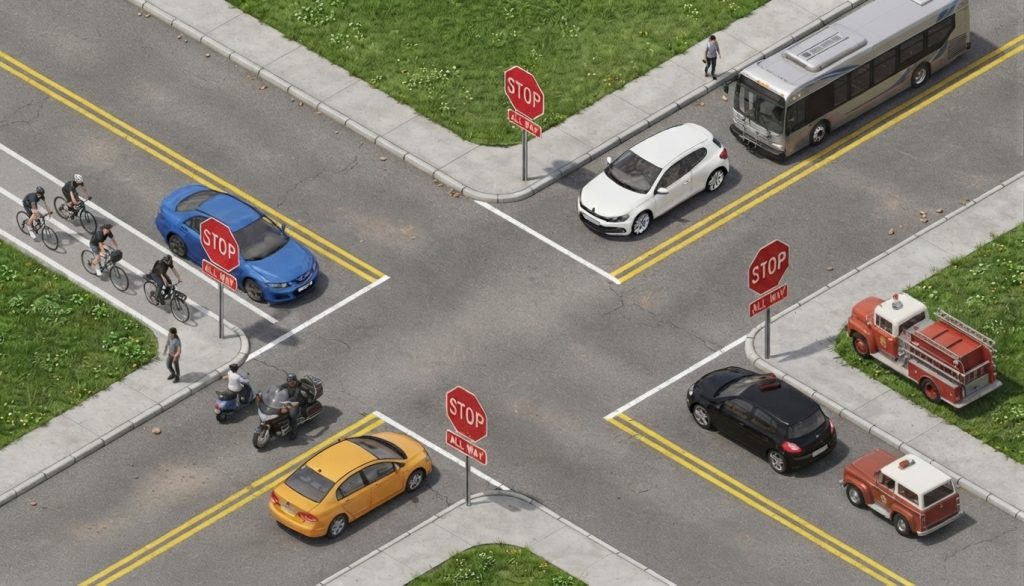
If you’ve ever reached an intersection at the same time as another driver, you probably know how confusing it can be. Everyone stops, everyone looks around, and for a second, nobody seems sure who should move first.
That’s exactly why understanding a 4 way stop is important. These intersections are designed to organize traffic without traffic lights, but they only work properly when drivers understand when they should stop and when they can safely proceed.
The rules aren’t particularly complicated. The tricky part is knowing how to apply them when several vehicles arrive together.
What Is a 4 Way Stop?
A 4 way stop is an intersection where vehicles approaching from all four directions are required to stop.
You’ll normally see a stop sign at each approach. Sometimes there’s an additional sign below it that says “4 Way” or “All Way.” This tells drivers that the other directions have stop signs as well.
When you approach one, slow down and prepare to stop completely. Don’t simply reduce your speed and continue through the intersection. Your vehicle needs to come to a full stop.
Once you’ve stopped, look around before deciding what to do next. Check for vehicles, pedestrians, bicycles, and anything else that could enter your path.
How Do 4 Way Stop Rules Work?
The basic 4 way stop rules depend mainly on when vehicles arrive at the intersection.
If you arrive and stop before another vehicle, you generally get the opportunity to go first. The same applies in reverse. If another vehicle has already stopped and you arrive afterward, you should normally wait.
The situation becomes less obvious when two vehicles arrive at about the same time.
In that case, the vehicle on the right generally goes first. The driver on the left should yield and allow the other vehicle to proceed.
For example, imagine two cars reach the intersection at almost exactly the same moment. One car is on your right. Unless another rule or traffic situation changes things, you should allow that car to go first.
It’s a simple rule, but remembering it can prevent a lot of hesitation.
Who Has Right of Way at 4 Way Stop Intersections?
If you’re wondering who has right of way at 4 way stop intersections, start by considering which vehicle arrived first.
Arrival order is one of the most important factors. A driver who has already stopped at the intersection generally proceeds before a driver who arrives later.
When vehicles arrive simultaneously, the driver on the right generally has priority.
Turning movements can make things a little more complicated. Suppose you and another driver are facing each other. You’re planning to turn left while the other driver is going straight. In a typical situation, the driver going straight proceeds first, and the left turning driver waits.
Even then, don’t rely only on assumptions. Watch the other vehicle and make sure the driver isn’t doing something unexpected.
Traffic laws can differ depending on where you drive, so it’s always worth checking your local driving rules if you’re unsure about a specific situation.
What Does a Stop Sign 4 Way Mean?
A stop sign 4 way intersection means traffic approaching from every direction must stop.
The extra “4 Way” sign isn’t giving you a special instruction to do something different from a normal stop sign. Instead, it tells you that traffic coming from the other approaches also has a stop sign.
This matters because you shouldn’t assume that you automatically have to wait just because you’re at a stop sign. Other drivers have to follow their signs too.
Once you’ve stopped, pay attention to which vehicles arrived first and whether anyone is turning.
What Happens When Several Cars Arrive Together?
Things can get confusing when three or four vehicles arrive at nearly the same time.
Don’t try to force your way through simply because you’re unsure who should go. Watch the other drivers and give everyone enough time to react.
If another driver clearly gestures for you to go, you can still check that the intersection is safe before moving. A hand gesture doesn’t remove your responsibility to make sure there isn’t another vehicle or pedestrian in your path.
Sometimes, one driver may hesitate and another driver may wave them through. That’s normal. The important thing is that everyone understands what is happening before entering the intersection.
What About Pedestrians and Cyclists?
Right of way isn’t only about cars.
When leaving a stop, look carefully for pedestrians crossing the road. Depending on local traffic laws, pedestrians may have priority in marked or unmarked crosswalks.
Cyclists can also approach an intersection quickly and may be harder to notice, particularly at night or when other vehicles block your view.
Take a moment to check all directions before moving. Being technically first doesn’t mean it’s safe to go if someone else is already crossing.
Common Mistakes at Four Way Stops
One of the most common mistakes is making a rolling stop. A driver slows down but never actually stops. This can make it difficult for other drivers to know whether that vehicle is going to remain stopped.
Another mistake is focusing only on the car directly in front of you. You should also look to the sides and check what’s happening across the intersection.
Some drivers also become impatient when another vehicle hesitates. Honking or rushing forward usually makes the situation worse.
If you’re unsure, waiting for a second is often the safest option.
How to Handle a 4 Way Stop Safely
The best approach is fairly straightforward. Slow down as you approach, stop completely, and look around.
Figure out which vehicles arrived first. If another vehicle arrived at the same time, check whether it is on your right. Pay attention to vehicles going straight and those making turns.
Most importantly, don’t assume that every other driver will follow the rules perfectly. People get distracted, make mistakes, or misunderstand an intersection.
Your job is to drive defensively and make sure the road is clear before moving.
Final Thoughts
A four way stop may look like a simple intersection, but knowing the basic right of way rules makes a big difference.
Stop completely, pay attention to arrival order, and remember the right side rule when vehicles arrive at the same time. Keep an eye out for pedestrians and cyclists, and don’t rush just because you think it’s your turn.
When everyone stays patient and alert, these intersections can work smoothly without traffic lights.